
IONBOOST: Ford’s electric future just got a name you can actually say out loud: IONBOOST. After years of quietly developing battery chemistries, in-house controls and new EV platforms, Ford is now formalising the brand that will sit at the heart of its next wave of electric vehicles — and it matters more than a logo. This article explains what IonBoost is, why Ford is doubling down on in-house battery strategy, what it means for drivers and the industry, and how this fits into Ford’s broader electrification goals.
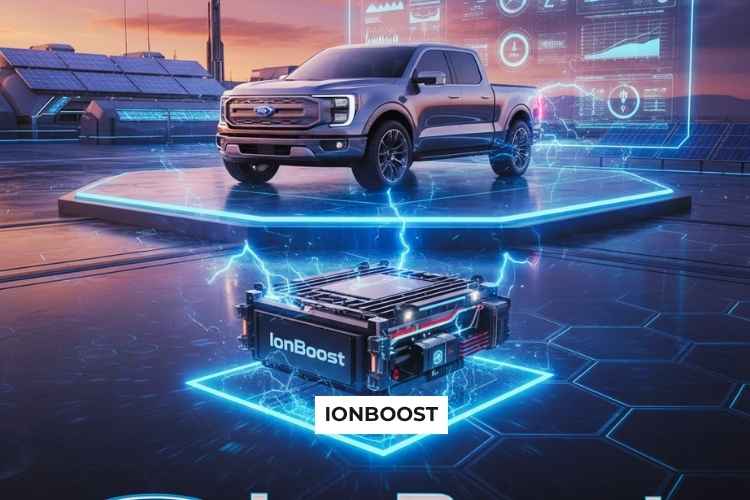
Table of Contents
What is IONBOOST?
IonBoost is Ford’s battery branding for the family of lithium-ion (and related) battery systems the company intends to use across future EVs — from passenger cars to light-commercial vehicles. The name first surfaced publicly during Ford’s 2021 strategy disclosures, and recent filings and coverage indicate the automaker is now pushing it into the spotlight as a named capability that customers and fleet buyers will see on badges and spec sheets.
Why branding a battery matters
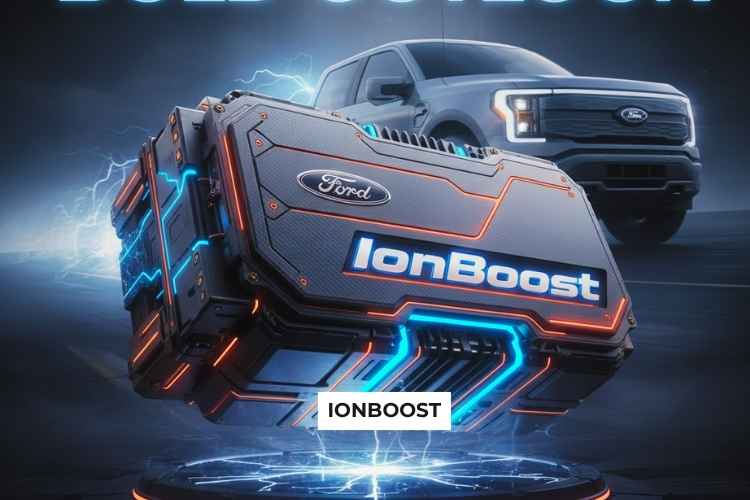
Car buyers used to care about engines, transmissions and horsepower. With EVs, the powertrain story increasingly revolves around batteries — range, charging speed, longevity, chemistry, and software that manages the pack. Branding a battery line (think: Toyota’s Prius battery lineage or BMW’s eDrive) does several things:
- Simplifies choice for customers. A named battery like IonBoost tells consumers there’s a coherent set of capabilities behind the badge instead of a maze of cell types and supplier names.
- Signals capability and differentiation. Ford can attach performance tiers (IonBoost, IonBoost Pro, IonBoost+) to distinguish entry, commercial and premium battery sets.
- Supports after-sale services and software monetisation. Branded batteries make it easier to package warranties, charging services, and over-the-air (OTA) battery management improvements.
Market context and competitive comparison
Other automakers have been branding battery systems and emphasizing integrated hardware + software. Tesla (with its cell-to-pack improvements and branded battery tech narratives), Volkswagen (cell partnerships, CTP architectures) and OEMs with joint ventures in Asia are all moving the same pieces. Ford’s play is to combine brand-level clarity (a simple name customers can latch onto) with manufacturing control and software competency.
Two quick data points to keep in mind:
- Ford announced increased EV investment and a target for 40% of U.S. volume to be all-electric by 2030 (a strategic commitment that underpins the need for IonBoost).
- The industry is chasing lower battery costs and higher energy density; Ford’s prior public target was roughly a ~40% battery-cost reduction goal by mid-decade, which makes in-house battery development both an engineering and financial priority.
Conclusion
Branding isn’t lipstick; it’s structure. IonBoost is Ford’s statement that batteries will be a customer-facing, serviceable, and evolving part of its EV value proposition — just like engines were for a century. It signals that Ford wants to control not just vehicle assembly, but the software, chemistry, and manufacturing that make EVs compelling and affordable.
If Ford pulls this off, IonBoost could make it easier for customers to understand tradeoffs (range vs cost vs durability), for fleets to specify vehicles, and for Ford to capture more long-term value through services and warranties. If they stumble, it will be an expensive reminder that branding must be backed by cells, science and supply chain muscle.

Bhakti Rawat is a Founder & Writer of InsureMyCar360.com. This site Provides You with Information Related To the Best Auto Insurance Updates & comparisons. 🔗