
EV Tech Trends: The electric vehicle (EV) revolution isn’t just about batteries anymore. While range and charging speed remain hot topics, the real transformation happening behind the scenes goes beyond batteries. Automakers and tech companies are racing to reimagine what driving feels like from how cars talk to each other, to how they charge themselves, and even how they think.
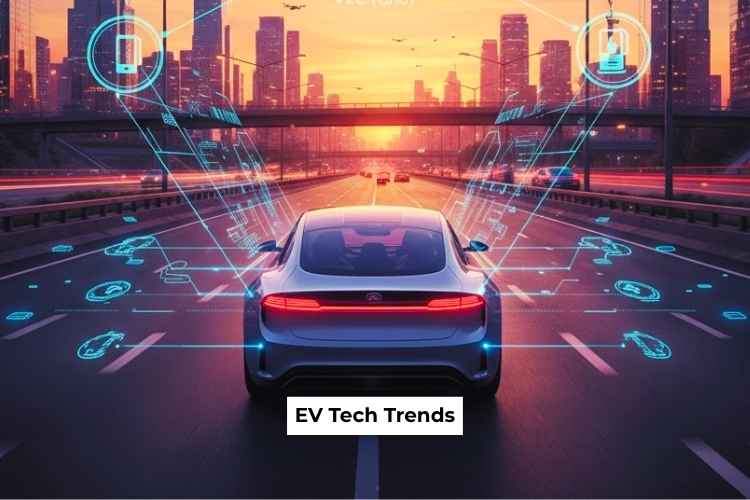
Table of Contents
EV Tech Trends: Vehicle-to-Everything (V2X)
If the EVs of the past decade were connected, the EVs of 2026 will be conversational. Vehicle-to-Everything (V2X) communication allows electric cars to exchange data with traffic lights, road sensors, other cars, and even the power grid.
- V2V (Vehicle-to-Vehicle): Improves safety by letting cars share speed and location data instantly.
- V2I (Vehicle-to-Infrastructure): Connects to smart roads and signals for optimized traffic flow.
- V2G (Vehicle-to-Grid): Lets cars return energy to the grid when parked, stabilizing electricity supply during peak demand.
EV Tech Trends: Solid-State Batteries
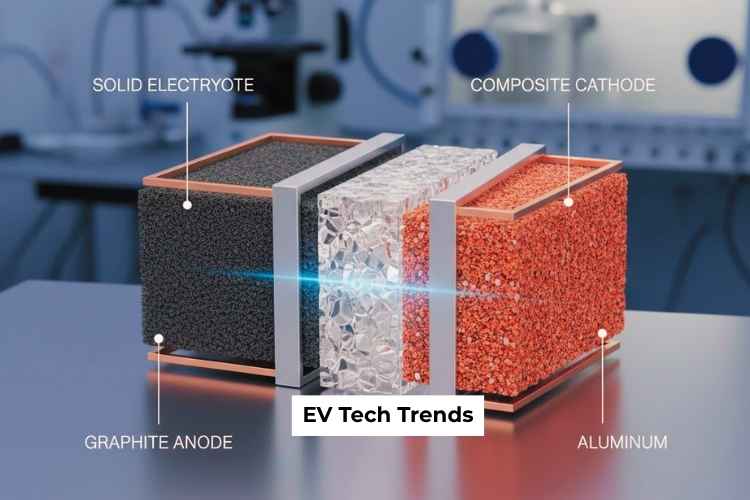
Yes, we said “beyond batteries,” but solid-state tech deserves mention because it completely changes what a battery is. Unlike today’s lithium-ion cells filled with liquid electrolytes, solid-state batteries use solid ceramic or polymer materials, which means:
- Faster charging: 80% in under 10 minutes.
- Higher energy density: Up to 50% more range in the same size pack.
- Better safety: No flammable liquids, lower risk of overheating or fire.
Toyota and QuantumScape are leading the charge, with pilot production expected in 2025–2026. Nissan, meanwhile, plans to launch its first solid-state-powered vehicle in 2028 — but test models are already running.
EV Tech Trends: Autonomous & Assisted Intelligence
By 2026, self-driving cars won’t just follow pre-set routes; they’ll learn from you. Advances in artificial intelligence (AI) and machine learning are turning EVs into adaptive companions.
- Level 3 autonomy (where cars can handle most conditions with limited human intervention) will become common in premium EVs by 2026.
- Predictive AI systems will analyze road, weather, and driver fatigue data to adjust vehicle behavior dynamically.
Ultra-Fast Charging & Wireless Power
Range anxiety may soon be replaced by “charging impatience.” EV makers are working to make charging nearly as quick as filling a gas tank.
The 2026 generation of chargers — built on 800-volt architectures pioneered by Porsche, Hyundai, and BYD — can add 300 km (≈186 miles) of range in under 10 minutes using 350 kW+ public chargers.
But the real game-changer? Wireless charging.
Companies like WiTricity and Stellantis are developing inductive pads that let you charge simply by parking over them. Some cities in South Korea and Norway are even testing dynamic wireless charging — where roads themselves supply power as you drive.
Software-Defined Vehicles (SDVs)
Gone are the days when your car’s features were frozen at purchase. The EVs of 2026 are software-defined vehicles (SDVs) — constantly evolving machines that receive over-the-air (OTA) updates for everything from performance to infotainment.
This shift is monumental because:
- Features on demand: You can “subscribe” to heated seats or advanced driver assists only when needed.
- Performance tuning: Manufacturers can adjust motor output, range, or braking feel via software updates.
- Security & diagnostics: Continuous data monitoring detects faults before they cause breakdowns.
Conclusion
The EV revolution began with batteries, but it won’t end there. As we step into 2026, these technologies will redefine driving as we know it — making cars faster to charge, safer to operate, and smarter to live with.
Electric mobility’s next chapter isn’t about more range — it’s about more intelligence, integration, and interaction.
The age of “beyond batteries” has officially begun.

Bhakti Rawat is a Founder & Writer of InsureMyCar360.com. This site Provides You with Information Related To the Best Auto Insurance Updates & comparisons. 🔗