
JSW’s Battery: India’s electric-vehicle (EV) transition is no longer just about selling more cars; it’s a strategic race to secure battery supply, manufacturing know-how and raw materials. At the center of this scramble is JSW Group, the diversified industrial conglomerate led by Sajjan Jindal, which is forging ties with Japanese and South Korean companies to build domestic battery-cell capability. This move could be a game-changer for India’s EV ecosystem: it helps reduce dependence on China, taps best-in-class technology from battery leaders, and aims to build gigascale capacity on Indian soil.
Table of Contents
JSW’s Battery: What’s happening
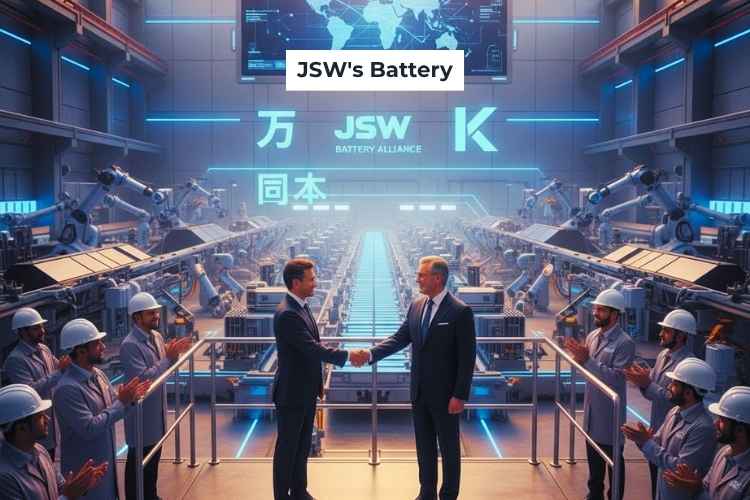
- JSW Group is in advanced talks with firms from Japan and South Korea to form a joint venture (JV) to manufacture battery cells in India — a move aimed at securing supply for JSW’s new-energy vehicle plans and cutting reliance on Chinese suppliers.
- JSW has also been linked in earlier reporting to discussions with LG Energy Solution (Korea) on a roughly $1.5 billion JV to set up an initial ~10 GWh plant — a deal that surfaced in late-2024 reporting and highlights the scale JSW is targeting.
- Separately, JSW has strategic tie-ups with Korean firms like POSCO and interest across Japan/Korea that include battery-materials and steel (important upstream inputs).
Why does JSW’s Battery want?
Three clear drivers:
1. Supply security. Cells and some critical battery components are still concentrated in a few countries (notably China, Korea, Japan). By partnering with trusted Japanese and Korean firms, JSW reduces the risk of supply shocks and technology blackboxes. Recent policy moves and trade frictions have increased the incentive to diversify suppliers.
2. Technology access. Japan and Korea house many of the world’s best cell-makers and equipment suppliers (e.g., LG, Samsung, Panasonic, Japanese cathode/anode innovators). Technology transfer via JV is the fastest way to close capability gaps.
3. Policy and economics in India. The Indian government’s Production-Linked Incentive (PLI) for Advanced Chemistry Cell (ACC) batteries and related incentives aim to create domestic gigafactories (50 GWh target under ACC PLI). That makes local manufacturing financially attractive and aligns corporate and national goals.
JSW’s Battery: comparison
| Topic | JSW Alliances with Japan/Korea — what it means |
|---|---|
| Primary aim | Build domestic cell manufacturing & secure supply for JSW’s EV/energy ambitions. |
| Likely partners | Korean majors (e.g., LG) and Japanese firms (materials, equipment); POSCO collaboration touches materials & steel inputs. |
| Initial capacity discussed | Reports pointed to ~10 GWh starter projects in some talks. |
| Policy tailwinds | India’s ACC PLI (50 GWh target) and other incentives to onshore cell manufacturing. |
| Key upside | Reduced import risk, local jobs, circular economy opportunities (recycling + storage). |
| Key risk | Execution, supply of active materials, tech obsolescence and margin pressure. |
Conclusion
JSW’s outreach to Japanese and Korean partners is a smart strategy: it aligns capital, technology and policy to build domestic cell capability. The moves reflect a broader national strategy diversifying away from concentrated suppliers and building industrial capacity that supports decarbonisation and energy security.
However, the real impact depends on execution: turning talks into operating gigafactories; building domestic upstream supply chains; and adapting to fast-moving battery technologies. Suppose JSW and its partners navigate these successfully. In that case, India’s EV future becomes not just a market story but a manufacturing success story and that would be a major stride toward energy independence and industrial modernisation.

Bhakti Rawat is a Founder & Writer of InsureMyCar360.com. This site Provides You with Information Related To the Best Auto Insurance Updates & comparisons. 🔗